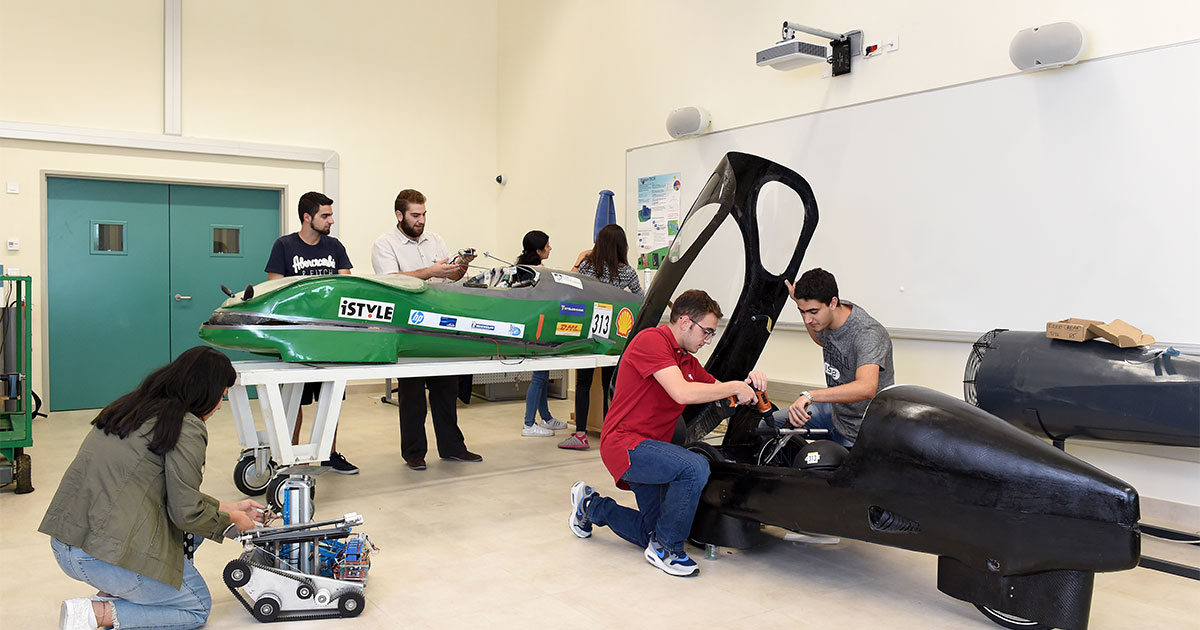
Engineering Ventures Track (EVT)
Great ventures start as engineering problems.
Got an idea, a project, or just the drive to build something? The Engineering Ventures Track (EVT) helps LAU engineering students turn it into a real product, designed, tested with real users and ready for the market, as part of their degree.
What Is EVT?
EVT is a track: an optional path within the engineering degree that helps students turn an idea into a validated product. It adds no credits and does not change degree plans.
Track, incubator or accelerator?
| What it is | When | What it offers | |
| Track (EVT) | An optional path inside the degree, built from courses and faculty reviews | While you study, from first idea to validated product | Course credit, faculty guidance, lab access, and a working prototype with evidence of demand |
| Incubator | A program that hosts young companies, usually for several months, to help them get established | After a company is formed | Workspace, mentoring and business services |
| Accelerator | A short, intensive program for startups that already have a product and early customers | When a startup is ready to grow fast | Intensive mentoring, access to investors, often a final demo day |
Idea → EVT → incubator → accelerator. EVT is the first step: it gets an engineering idea ready for what comes next.
The EVT Method: Design. Validate. Commercialize.
Every EVT venture follows the same three steps:
- Perfect the product: Turn the idea into a working prototype, then a minimum viable product, with engineering faculty reviewing the design.
- Prove product–market fit: Test every assumption with real customers and bring evidence, not opinions, that people outside LAU want it.
- Choose the route to market: Decide how the product reaches customers and build the business model to match.
EVT is built on experiential learning: students learn by building something real, research finds its way to the people it can serve, and graduates leave knowing how to design, validate and commercialize an engineering innovation.
How It Works
- Submit your idea. A short online form, any time of the year.
- Confidential screening. A 20-minute conversation within two weeks.
- Faculty Review. A cross-department panel meets every two months, before registration, and places each idea on a route.
- Build. Work on your venture through the route that fits it.
After the Review, each idea is placed on one route:
- GNE 350: build the business case in the School’s new Signature course (3 credits).
- A course in your major: build the prototype as the project of a designated course. Credit comes through that course.
- Your own track: when no course fits, build through a supervised independent study with laboratory access and a faculty technical sponsor.
- Strengthen and return: sharpen the idea and come back to a later Review, up to twice.
- Redirect: the Engineers for Impact (E4I) Institute may suit the idea better.
- Not at this stage: the idea does not fit EVT yet.
GNE 350 Engineering Commercialization
The core course of EVT and a new School of Engineering Signature course, open to all engineering students, with or without an idea yet. It covers customers, value, business models and the route to market.
- Offered: Spring 2027
- Byblos: [Days and time to be announced]
- Beirut: [Days and time to be announced]
The EVT Year
- Fall: Submit your idea and go through screening and Review.
- Spring: Build, in GNE 350, in a course in your major, or on your own track.
- May, Validation Gate: Present a working prototype and evidence of real demand from outside LAU. Interviews alone are not enough.
- Summer: Keep building. This may be recorded as an internship, subject to approval.
- August Awards: Pitch to faculty and external judges, chaired by the Dean or Associate Dean.
Eligibility
Any LAU engineering student, at any stage, with or without an idea. Students may apply alone or as a team. Teammates from other LAU schools are welcome; each team names one engineering student as its lead.
Optional Certificate
GNE 350, a designated course in the major and an entrepreneurship or innovation course would earn the 9-credit Engineering Commercialization Certificate. All three courses also count toward the degree. The certificate is planned for 2027–28, subject to approval.
Where It Leads
- Stage 1, Build (open now): Build the venture inside your degree, through courses, faculty Reviews and the Validation Gate.
- Stage 2, Next: The strongest ventures graduate into acceleration and incubation within LAU’s wider startup ecosystem, ready to scale and raise investment.
Frequently Asked Questions
Do I get credit?
Credit comes through a course: GNE 350, or a designated course in your major. Students on their own track work through a supervised independent study.
My idea is still early. Should I apply?
Yes. Any engineering student can apply, at any stage.
I do not have an idea yet. Can I still join?
Yes. Choose “A student looking for an idea” on the form, and we will match you with a real problem to solve, a team that needs your skills, or a faculty member to work with.
Do I need a team?
No. Apply alone or as a team; a team names one engineering lead.
Is my idea protected?
Submissions and screening are confidential. Describe what the product does, not how it works, and we will advise you on protecting your work.
Apply
Applications are open year-round. Submit any time and we will reach out to you. The form takes about five minutes, with nothing to upload, and requires your LAU login.
Apply NowFaculty members can use the same form to refer a student with a promising idea.