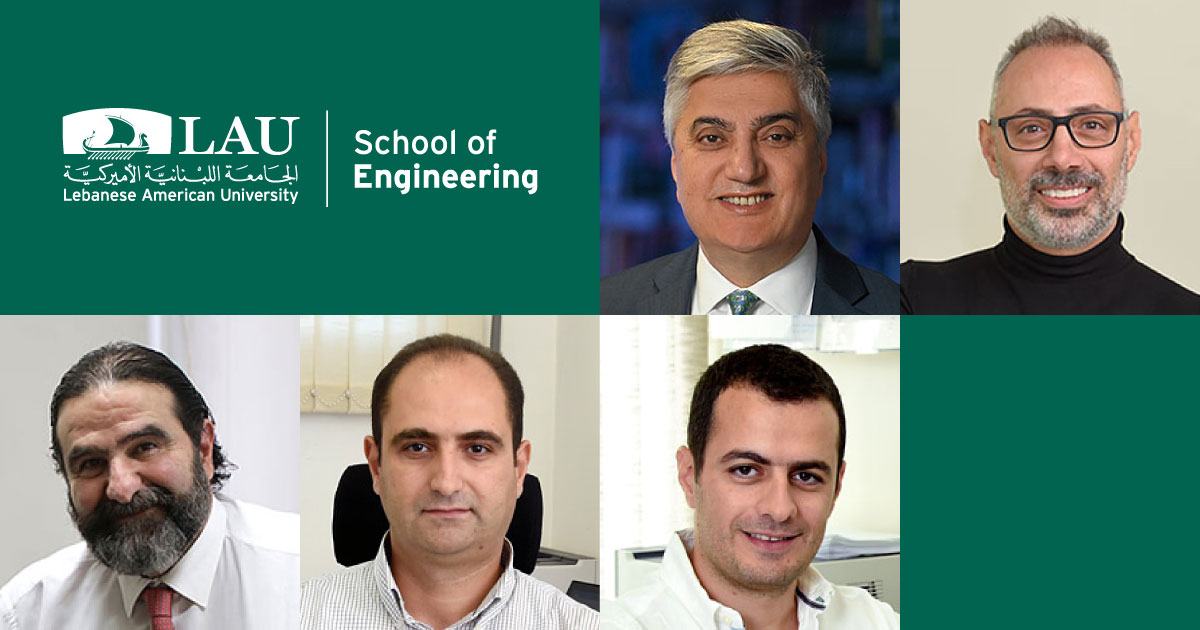
LAU School of Engineering Faculty Among the World’s Most-Cited Scientists
Five leading scholars from the LAU School of Engineering have earned a place among the world’s top two percent most-cited scientists in the 2025 Scopus Elsevier list, a recognition that underscores not only their individual excellence but also the school’s growing stature as a hub of high-impact research.
At the helm of this distinguished group is Professor and LAU President Chaouki T. Abdallah, whose academic interests span systems theory, complex networks, and higher education systems. Over the course of his career, he has advanced the understanding of control, communications, and computing systems—fields in which he has been recognized globally as a senior member of the IEEE and recipient of the IEEE Millennium Medal. He has published eight books, as co-editor for three of them and co-author for five, and contributed to more than 400 peer-reviewed articles.
Professor and Dean of the School of Engineering Michel El Khoury has long focused on computational and experimental fluid mechanics, with a particular interest in turbulence modeling and vertical-axis wind turbine designs. His research explores the aerodynamic performance and optimization of vertical-axis wind turbines, reflecting his pursuit of innovative methods to enhance efficiency and sustainability in renewable energy applications.
In electrical engineering, Professor Chadi Abou-Rjeily is widely known for his expertise in space-time codes and ultra-wideband (UWB) communications. His work explores advanced coding techniques for wireless and optical communication systems as well as cooperative UWB wireless networks, which have been central to improving the reliability of data transmission in challenging environments.
Professor Wassim Habchi brings deep expertise in tribology, the science of friction and lubrication, focusing on how parts like gears, bearings, and cam-followers move smoothly under high pressure. His interests lie in modeling the interactions of friction, heat, and material deformation in high-pressure systems, helping improve the performance and durability of industrial machinery.
Rounding off the list is Professor and Dean of Graduate Studies and Research Samer Saab, whose scholarly pursuits focus on robotics, control systems, and positioning technologies. His work has contributed to improving control systems for complex machines like robotic arms, developing indoor tracking using RFID technology, which uses small wireless tags to locate objects and people accurately inside buildings, and finding ways to boost GPS coverage for more precise navigation in automated systems.
The collective expertise of these five faculty members illustrates the breadth and depth of scholarship within the School of Engineering, spanning areas that continue to drive innovation across industries.
Their recognition comes as part of a broader success story for LAU, which saw 28 full-time faculty members named among the world’s most-cited scientists in 2025, up from 17 in 2023 and 25 in 2024.
“Being ranked among the world’s most-cited scientists is not only a remarkable personal achievement for our faculty, but also a reflection of LAU’s commitment to fostering research that is both meaningful and lasting in its impact,” said Provost George E. Nasr.
Published annually by Elsevier using a Stanford University–developed methodology, the ranking identifies the top two percent of scientists worldwide based on research impact and citation influence across 22 fields and 174 subfields.