3D Printing Techniques for Catalysts Synthesis and Their Applications to Methanation and Reforming Reactions
Project Details
- Student(s): Joseph Boutros
- Advisor(s): Dr. Nissrine El Hassan
- Department: Chemical
- Academic Year(s): 2025-2026
Abstract
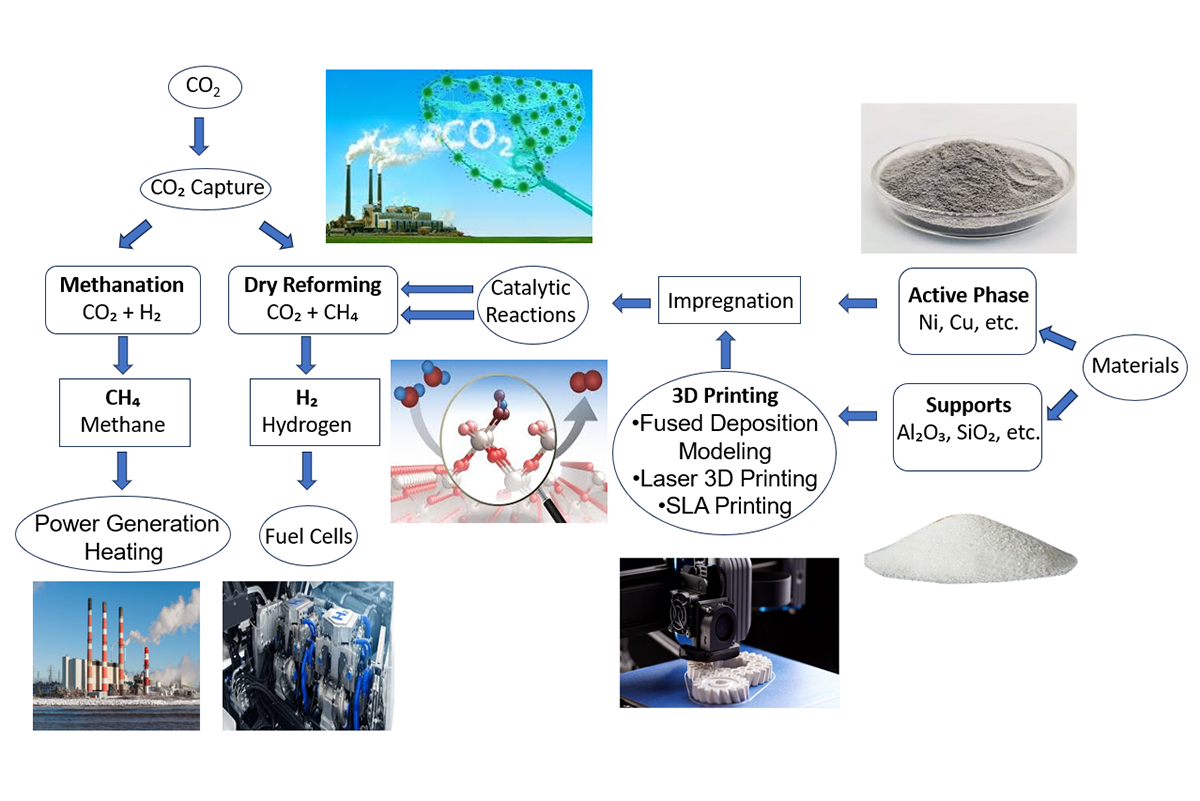
Global warming has recently attracted considerable attention due to its role as a major contributor to natural disasters. One solution to this issue involves reducing greenhouse gas emissions into the atmosphere and transforming these effluents into useful products. Methanation and dry reforming of methane are processes that treat carbon dioxide and convert it into valuable energy sources. However, these two reactions require efficient catalysts, alongside their reactants, in order to maximize the yield of useful products and maintain the economic viability of the processes. In most cases, 3D-printed catalysts exhibit superior properties compared to commercial catalysts in powder form, including higher surface area, pore volume, and mechanical stability, which make them suitable for methanation and reforming reactions that are often performed under extreme operating conditions. This review briefly discusses several 3D-printing techniques used to synthesize various catalysts, grouped into three main categories: material extrusion, vat photopolymerization, and powder-based methods. The physical characterization of these catalysts, as reported in the literature, is examined to identify the key properties that differentiate 3D-printed catalysts from commercial ones. These findings are then correlated with the catalytic performance of both types of catalysts in the methanation and reforming reactions, by comparing reactant conversion rates as well as useful-product yields and selectivity. In most cases, 3D-printed catalysts enhance the efficiency of both methanation and reforming, which is attributed to their superior physical properties, especially surface area.