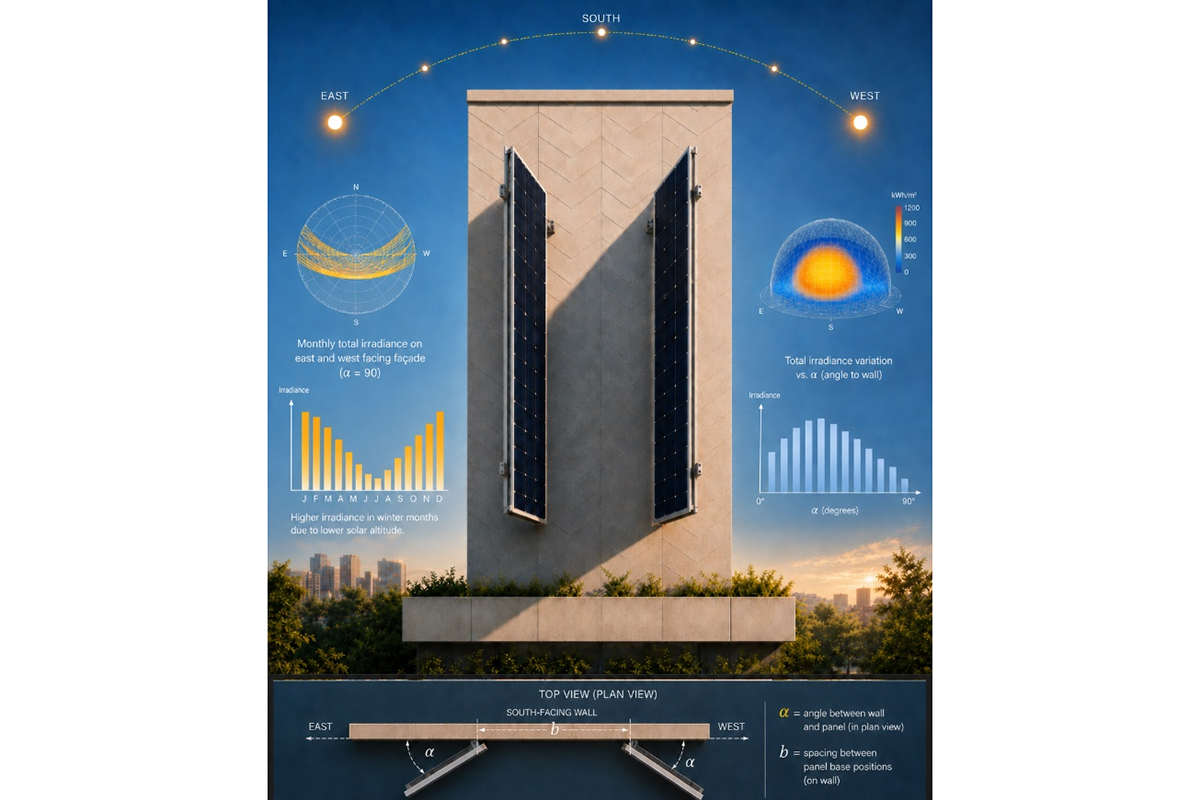
Annual and Monthly Irradiance Assessment of Vertical Façade PV Systems
Project Details
- Student(s): Hossam Tohme
- Advisor(s): Dr. Jimmy S. Issa and Dr. Pierre Rahme
- Department: Industrial & Mechanical
- Academic Year(s): 2025-2026
Abstract
Façade-integrated photovoltaic systems can increase the usable envelope area of buildings, but their performance depends strongly on surface orientation, wall geometry, and mutual shading between adjacent panels. This study develops a time-resolved irradiance model for a two-panel vertical façade configuration in which the panels remain vertical while rotating in plan view relative to a south-facing wall. The panel tilt is fixed at beta = 90°, while the plan-view angle alpha controls the azimuth of each panel and the clear spacing between their wall-mounted base edges. Measured multi-year global horizontal irradiance data from 2019 to 2024 are converted from UTC to true solar time, decomposed into beam and diffuse components using the Erbs method, and projected onto the panel planes using a Perez diffuse formulation. The performance of a single panel is assessed for all possible alpha over the course of the year. Then a one dimensional mutual shading model is applied to a two-panel system. Under the binary/Full-cut shading assumption used in this version, any non-zero shading fraction causes the affected panel to be fully cut off for that timestep. Results are presented in terms of monthly and annual two-panel irradiation, as well as a wall-span-normalized metric J = E2/b. The findings show strong dependence on the spacing factor n and plan-view angle alpha, with tight spacing producing higher wall-normalized yield but stronger shading sensitivity. The model provides a structured basis for comparing façade packing density and orientation strategies before moving to full three dimensional ray tracing or electrical mismatch modelling.