Design of Hydrogen Production Catalysts Using Machine Learning
Project Details
- Student(s): Michel Abboud
- Advisor(s): Dr. Nissrine El Hassan
- Department: Chemical
- Academic Year(s): 2025-2026
Abstract
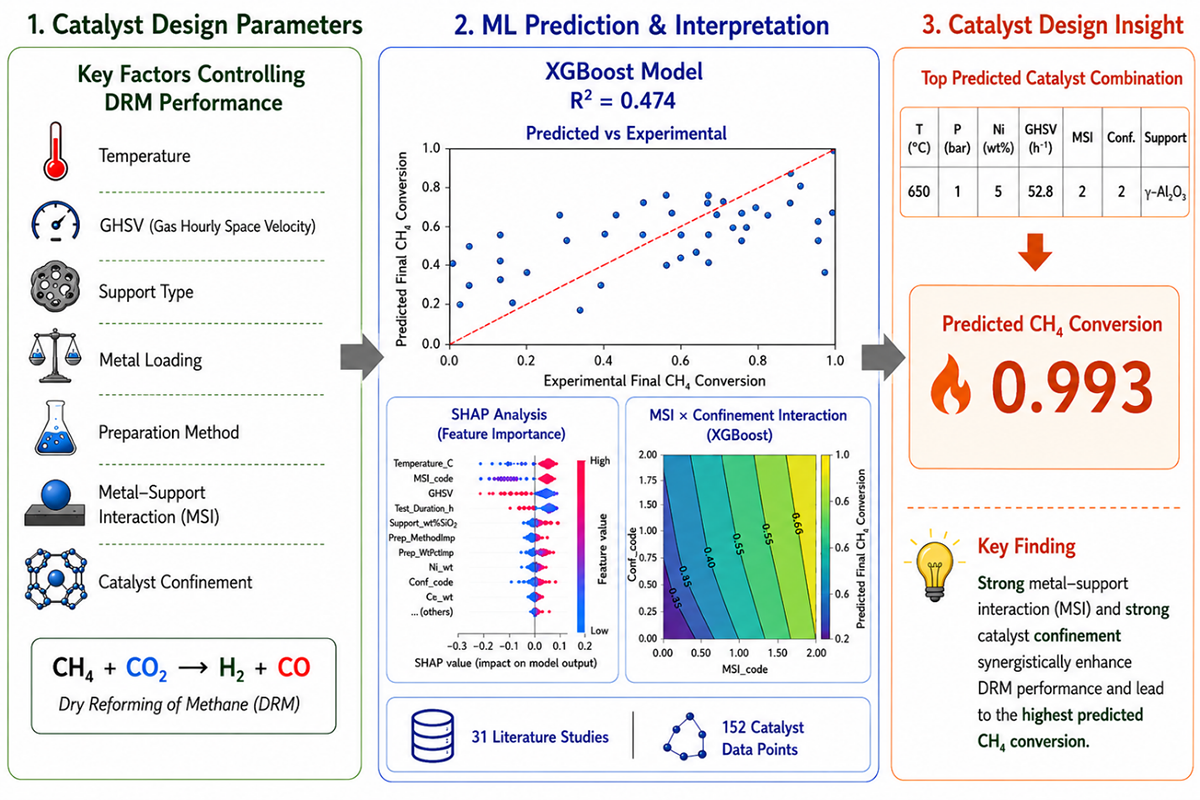
Dry Reforming of Methane (DRM) is a promising process for converting methane (CH₄) and carbon dioxide (CO₂) into synthesis gas (H₂ and CO), while simultaneously valorizing two major greenhouse gases. However, catalyst performance is influenced by numerous interacting factors including catalyst composition, operating conditions, metal-support interactions (MSI), and confinement effects, making catalyst optimization challenging. In this work, a literature-derived dataset containing 152 experimental DRM catalyst datapoints was constructed from 31 published studies. Machine learning models including Random Forest, XGBoost, CatBoost, and Artificial Neural Networks were developed to predict methane conversion and identify the most influential parameters governing catalyst performance. Interpretability tools such as feature importance analysis, partial dependence plots, SHAP analysis, and interaction mapping were employed to uncover structure-performance relationships. The results demonstrated that temperature, MSI, confinement effects, and catalyst composition are among the most significant factors affecting DRM performance. This work highlights the potential of interpretable machine learning as a powerful tool for accelerating catalyst design and optimization for sustainable hydrogen production.