Effectiveness of Fuel Reduction Against Surface Fire Propagation
Project Details
- Student(s): Charbel Karam and Charbel Farhat
- Advisor(s): Dr. Gilbert Accary
- Department: Industrial & Mechanical
- Academic Year(s): 2025-2026
Abstract
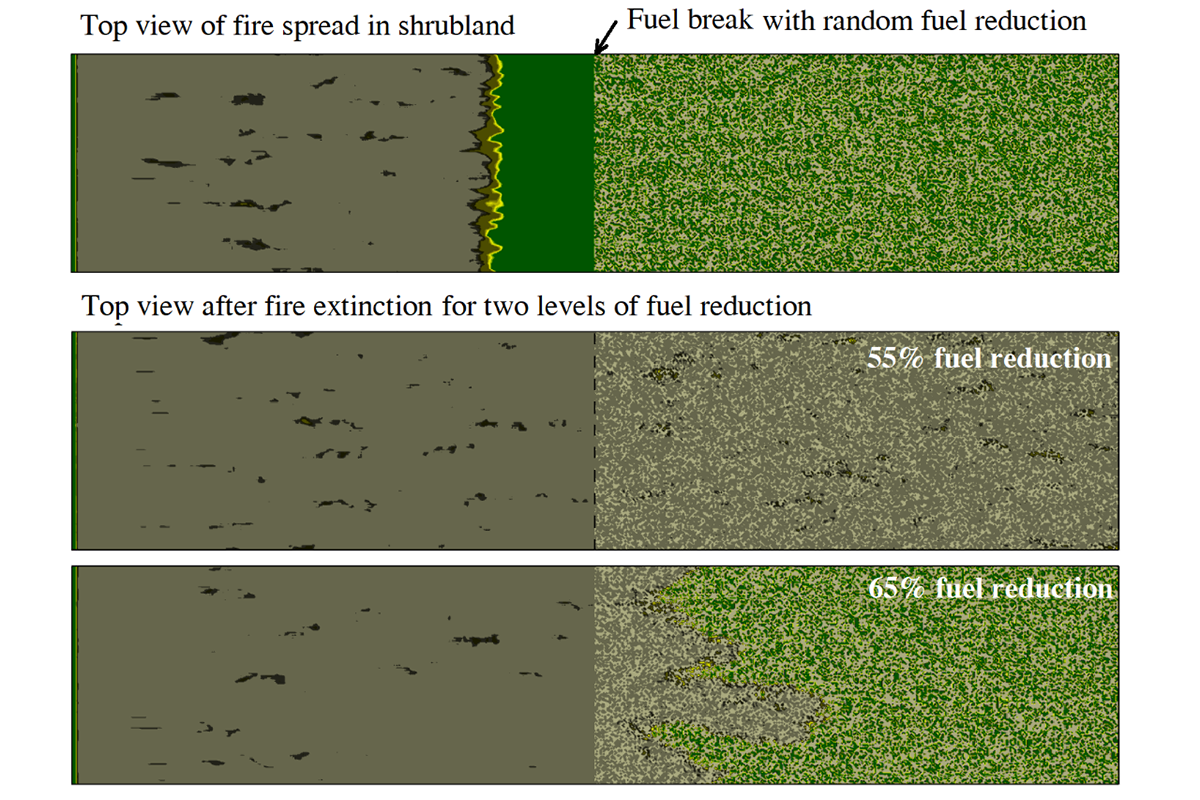
Globally, wildfires are an increasing threat to infrastructure and human lives, with their scale rising due to phenomena such as climate change, land-use changes, and urban expansion into fire-prone regions. Increasing firefighting means alone is insufficient to mitigate these risks, making fuel management strategies essential. In this context, fuel-breaks, defined as areas where the fuel load is reduced either uniformly or randomly, represent an effective approach to limit wildfire propagation. This study aims to determine the threshold value of fuel-reduction percentage required to stop a steady surface fire propagation under uniform and random fuel reduction, and the corresponding fuel-break width associated with this threshold condition. Numerical simulations of shrubland fires are conducted through fuel-breaks using FireStar3D, a fully physical, multiphase CFD fire simulator. Two fuel-reduction approaches are considered: homogeneous reduction of fuel packing ratio and random reduction of fuel coverage. The results identify a critical threshold value of fuel-reduction percentage, beyond which fire propagation is no longer sustained. This threshold is shown to strongly depend on the reduction method, leading to distinct critical values for homogeneous and random fuel reduction. Additionally, the fire penetration distance within the fuel-break prior to extinction varies with these methods, reflecting differences in fire behavior and energy transfer mechanisms. These findings demonstrate that both the magnitude and spatial distribution of fuel reduction play a decisive role in wildfire suppression effectiveness, with method-dependent variations significantly impacting fire extinction conditions. This work provides quantitative guidelines for the design of optimized fuel-breaks, enabling more reliable prediction of wildfire containment and supporting risk reduction strategies to prevent wildfires from escalating into uncontrollable events.