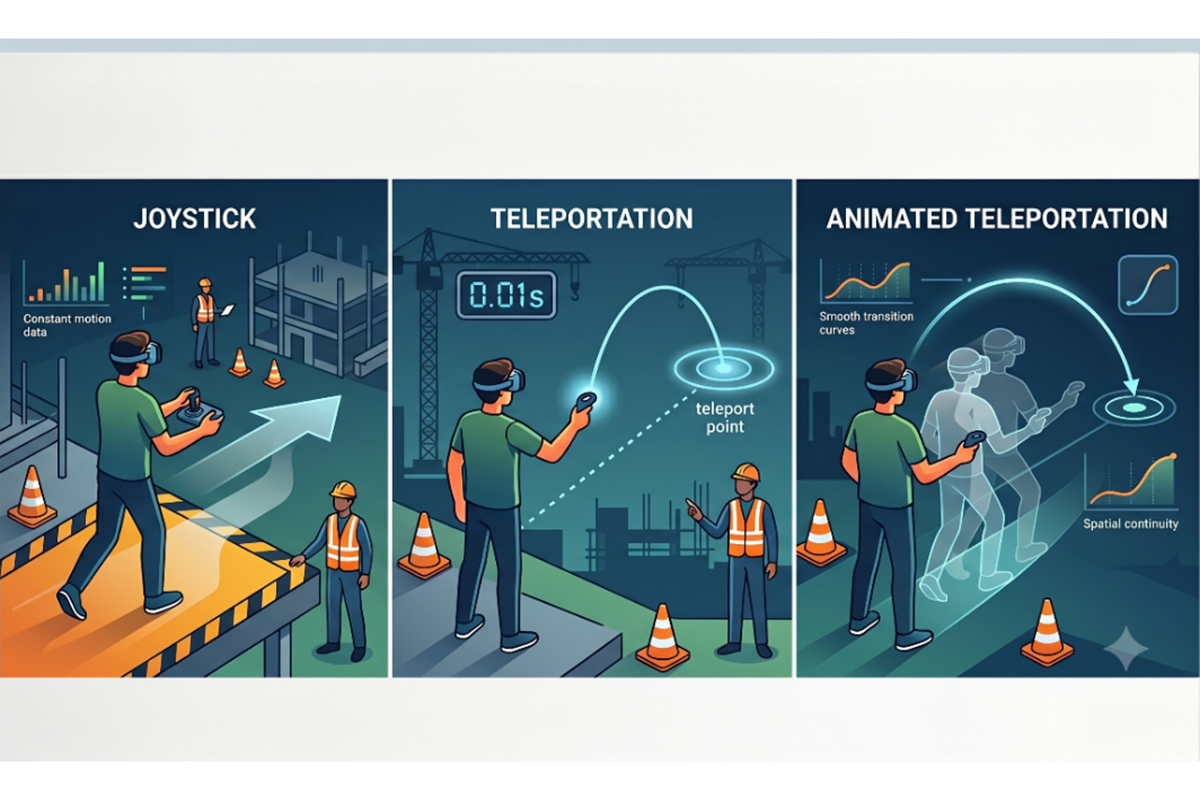
Evaluating Virtual Reality Locomotion Methods for Construction Safety Training: A Comparative Study of Joystick, Teleportation, and Animated Teleportation
Project Details
- Student(s): Rayan El Halabi, Karen Kfoury
- Advisor(s): Dr. Evan Fakhoury
- Department: Industrial & Mechanical
- Academic Year(s): 2025-2026
Abstract
Background: Traditional construction safety training often lacks immersion, leading to limited hazard retention. Virtual Reality (VR) offers a high-fidelity alternative, but the choice of user locomotion directly impacts spatial awareness and cyber-sickness.
Objective: This study evaluates the effectiveness of three VR locomotion methods: continuous Joystick, instant Teleportation, and a novel Animated Teleportation, within a simulated construction safety context.
Methodology: Utilizing a randomized controlled design, participants navigate a virtual construction site to identify standard site hazards. Performance is quantified across three primary dimensions:
- User Experience (UX): Assessing perceived immersion and intuitive control.
- Cyber-sickness: Measuring physiological discomfort and nausea via standard simulators.
- Spatial Awareness: Evaluating the participant’s layout retention and hazard-tracking accuracy post-navigation.
Expected Results: Continuous joystick navigation is anticipated to maximize immersion but yield higher cyber-sickness. Instant teleportation will minimize discomfort but disrupt spatial orientation. Animated teleportation is hypothesized to bridge this gap, offering a balanced mitigation of cyber-sickness while preserving critical spatial continuity.
Significance: These insights will provide actionable design frameworks for developers optimizing future immersive workforce training applications.