Geometric Self-Shading Effects in Rear-Irradiance Models for Bifacial PV
Project Details
- Student(s): Mario Shebaby
- Advisor(s): Dr. Jimmy Issa and Dr. Pierre Rahme
- Department: Industrial & Mechanical
- Academic Year(s): 2025-2026
Abstract
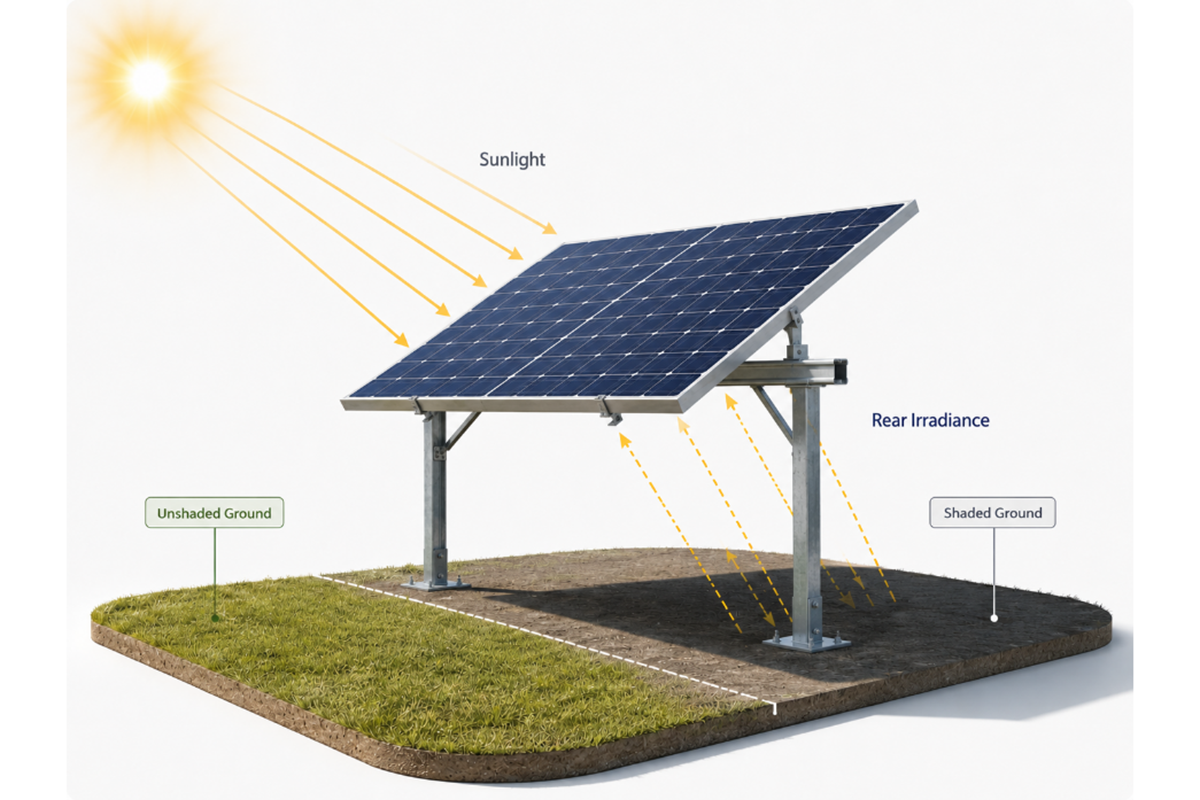
This project studies how geometric self-shading affects the rear-side irradiance received by elevated bifacial photovoltaic panels. A numerical view-factor model was developed by dividing both the panel and the ground into finite elements, separating shaded and unshaded ground regions, and accounting for direct, diffuse, and ground-reflected irradiance. The model was applied to Phoenix, Arizona using six years of 5-minute irradiance data from 2019 to 2024. The results showed that ground reflectance and panel height have a strong effect on yearly irradiation, while neglecting rear-side shading can overestimate the rear-reflected contribution by around 12% in some cases. The effect was found to be more important at low mounting heights, low tilt angles, and during periods when the rear-side contribution is high. Overall, the study highlights the importance of including ground self-shading effects in bifacial PV models to improve rear-irradiance and energy-yield predictions.