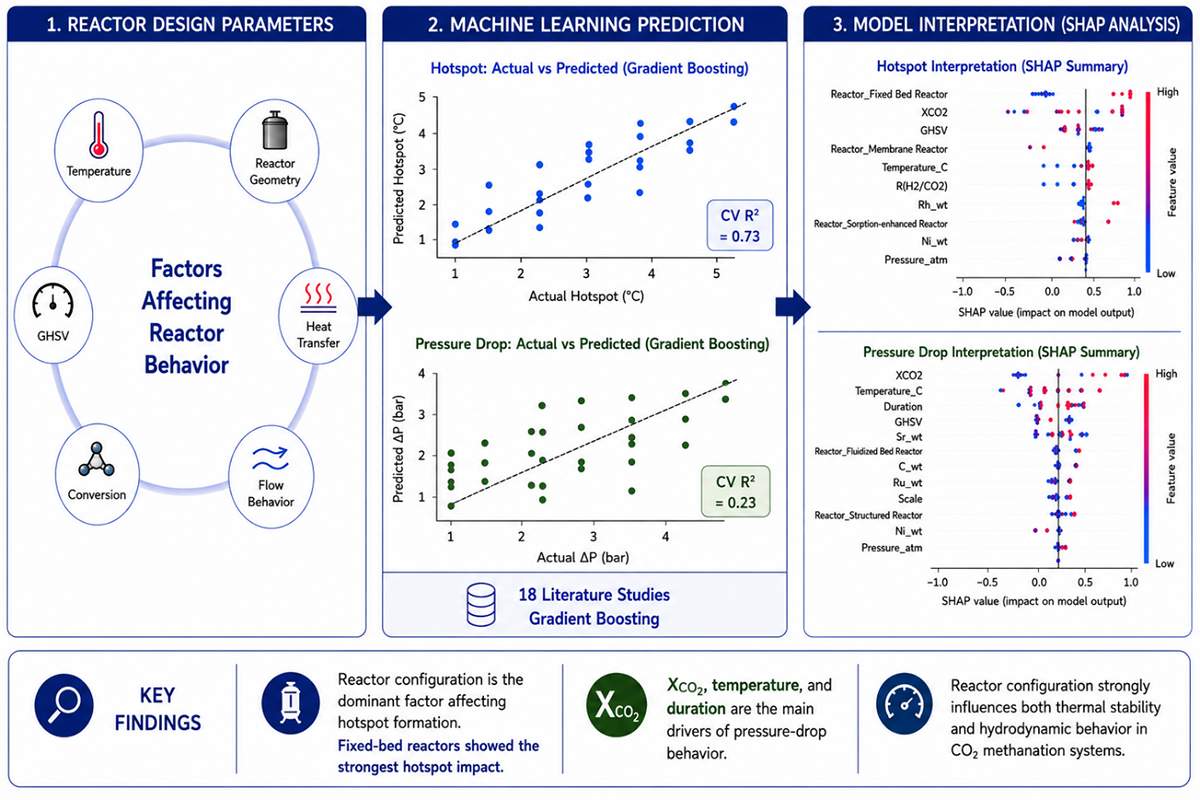
Machine Learning Analysis of Reactor Configuration Effects on Pressure Drop and Hotspot Formation in CO₂ Methanation Reactors
Project Details
- Student(s): Abbas Al Dilati
- Advisor(s): Dr. Nissrine El Hassan
- Department: Chemical
- Academic Year(s): 2025-2026
Abstract
CO₂ methanation is a promising Power-to-Gas technology that converts carbon dioxide and hydrogen into methane, enabling carbon utilization and renewable energy storage. However, the highly exothermic nature of the Sabatier reaction often leads to operational challenges such as hotspot formation and pressure drop, both of which strongly depend on reactor configuration. In this work, a literature-derived dataset was constructed from approximately 20 published studies covering multiple reactor technologies, catalyst properties, and operating conditions. Qualitative observations regarding hotspot severity and pressure drop were converted into numerical scores on a standardized 1-5 scale to enable machine learning analysis. Random Forest and Gradient Boosting models were developed to predict these reactor performance indicators and identify the most influential governing parameters. Model interpretation through feature importance analysis and SHAP explainability revealed that reactor type, CO₂ conversion, temperature, and flow-related parameters play significant roles in determining reactor behavior. The results demonstrate the potential of interpretable machine learning as a screening tool for reactor design and optimization in CO₂ methanation systems.