Optimal Sucrose Transport in the Phloem
Project Details
- Student(s): Bader Damaj
- Advisor(s): Dr. Mazen Nakad
- Department: Chemical
- Academic Year(s): 2025-2026
Abstract
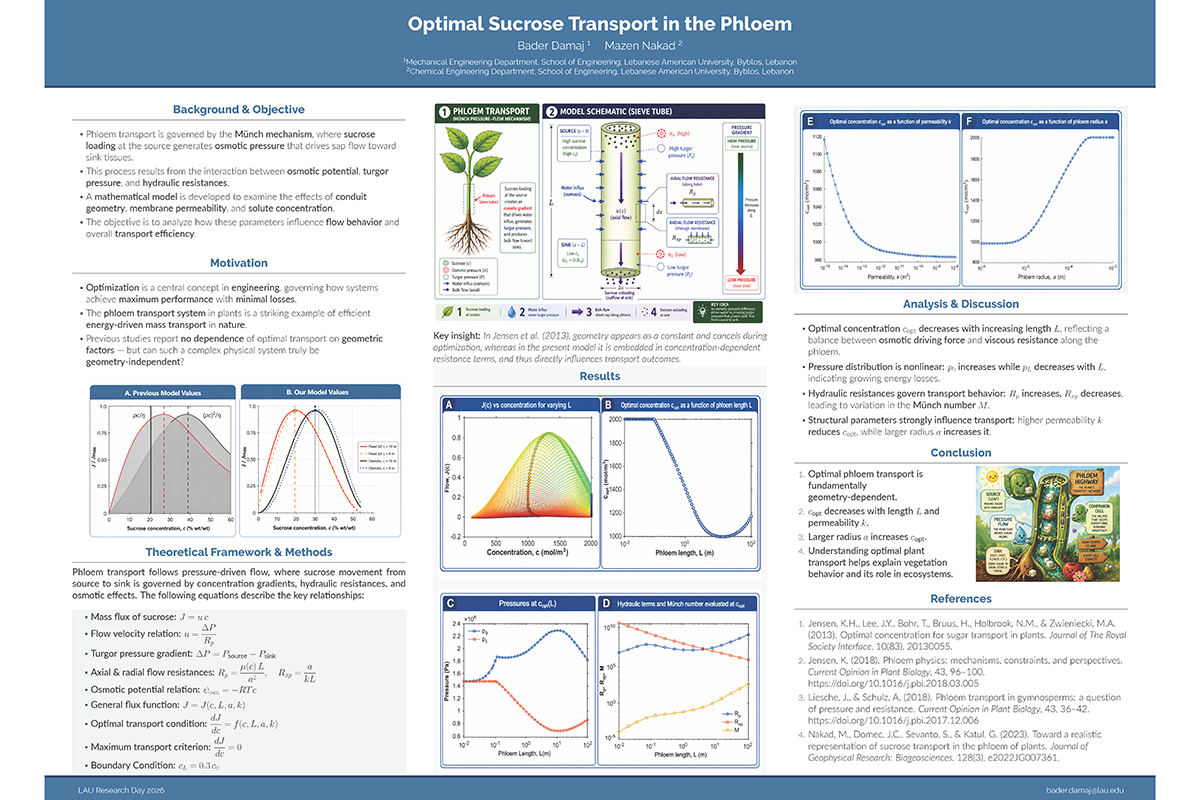
Photosynthetic carbon assimilation in leaves produces sucrose that must be efficiently transported to distant tissues through the phloem. This process is commonly described by the Münch pressure—flow mechanism, where osmotic loading at the source draws water from the xylem, increases hydrostatic pressure, and drives bulk flow toward sinks. Although conceptually simple, transport efficiency depends on the interaction between plant geometry, hydraulic resistances, osmotic gradients, and boundary constraints. In this study, we develop a coupled hydraulic—osmotic model to quantify sucrose transport and identify conditions that maximize efficiency.
The model incorporates viscosity-dependent axial resistance, radial phloem—xylem permeability, and gravitational effects on the soil—leaf water potential gradient. Sucrose flux is expressed as J(c) = u(c) c, where velocity arises from the balance of hydrostatic, osmotic, and water-potential forces. By varying phloem radius, length, and permeability across physiological ranges, we determine how these parameters influence the optimal concentration that maximizes flux. We focus on a scenario where the sucrose concentration at the sink (x = L) is a fixed proportion of the source concentration.
Results reveal a clear relationship between system parameters and both maximum flux and optimal concentration. Variations in geometry and permeability shift transport regimes, highlighting nonlinear coupling between resistance and osmotic driving forces. These findings show that efficient transport arises from parameter-dependent optimal states, providing a framework for understanding phloem transport and guiding comparison with experimental observations.