Optimization of ABE Fermentation Downstream Processing and Separation Techniques
Project Details
- Student(s): Lana Maria Lteif
- Advisor(s): Dr. Elie Chalhoub; Co-contributor: Dr. Joanne Belovich, Professor, Chemical Engineering Department, Cleveland State University, Ohio, USA.
- Department: Chemical
- Academic Year(s): 2025-2026
Abstract
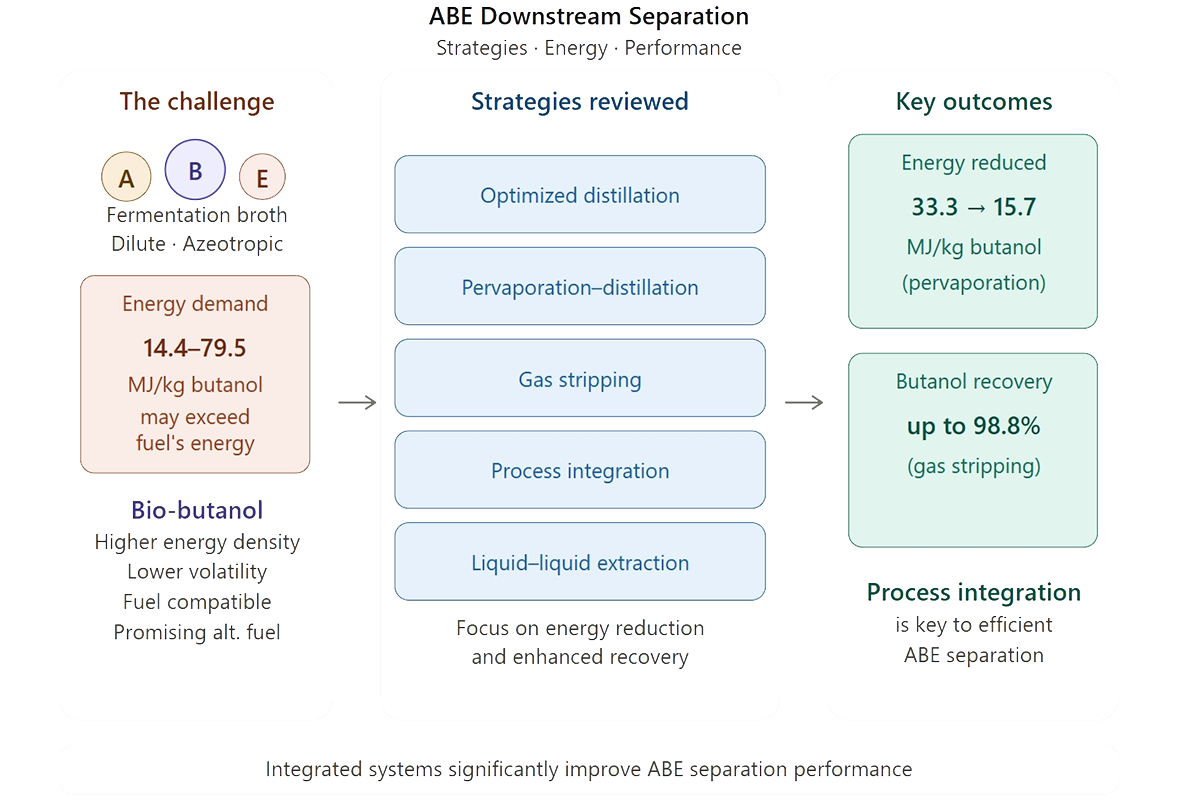
Recent strategies are being developed to reduce the high energy demand and economic limitations of acetone–butanol–ethanol (ABE) downstream separation. Although bio-butanol is a promising alternative fuel because of its higher energy density, lower volatility, and better compatibility with existing fuel infrastructure compared to ethanol [1], its recovery remains challenging due to the dilute fermentation broth and the complex azeotropic behavior of ABE mixtures [1,2]. Conventional separation systems can require between 14.4 and 79.5 MJ/kg butanol, which in some cases exceeds the fuel’s own energy content [4]. For this reason, the review focuses on optimized distillation systems, hybrid pervaporation–distillation processes, gas stripping, process integration, and liquid–liquid extraction. The reviewed studies show that integrated systems can significantly improve process performance; for example, hybrid pervaporation reduced energy consumption from 33.3 to 15.7 MJ/kg [1], while gas stripping–pervaporation achieved butanol recoveries up to 98.8% [5].