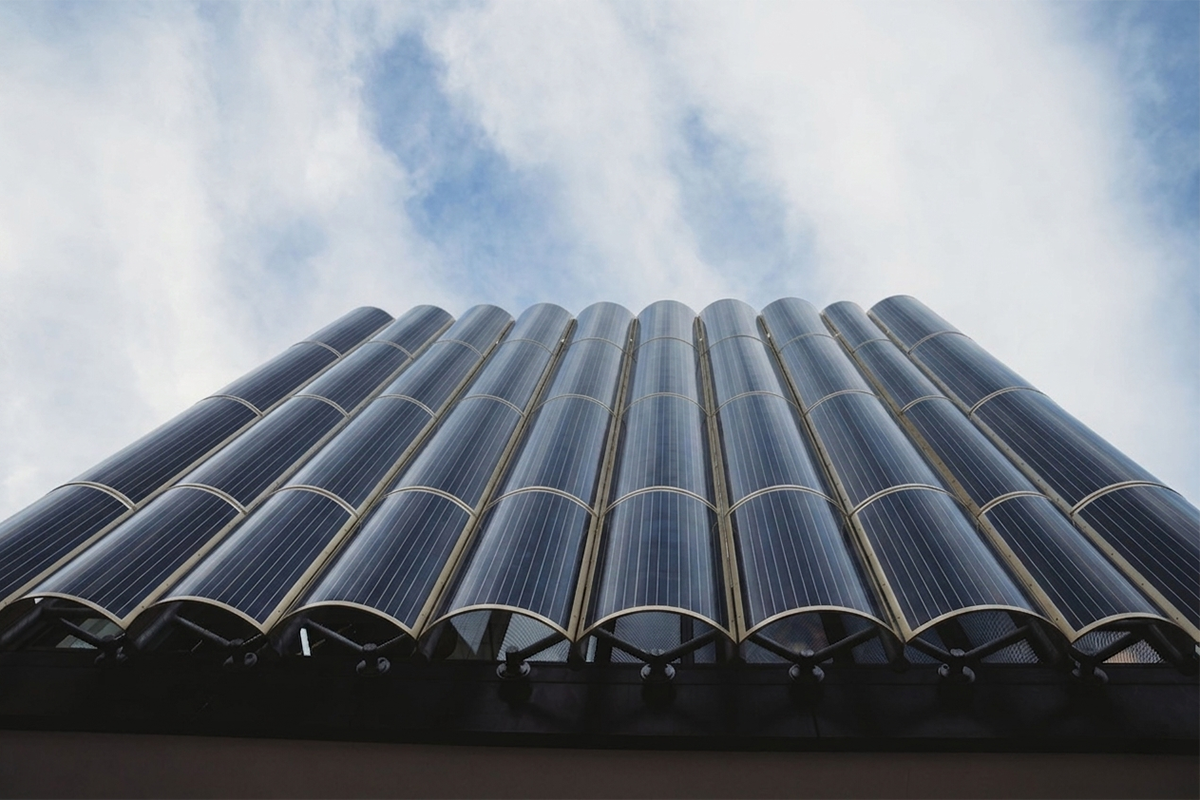
Optimization of Façade-mounted Photovoltaic Panels
Project Details
- Student(s): Johnny Moubarak
- Advisor(s): Dr. Jimmy Issa and Dr. Pierre Rahme
- Department: Industrial & Mechanical
- Academic Year(s): 2025-2026
Abstract
Building-integrated photovoltaics (BIPVs) present a promising route to integrate renewable energy into urban environments, especially façade-mounted configurations. Recent studies have investigated how panel geometry, orientation, and system enhancements like reflectors or tracking affect energy yield and building performance. In particular, curved modules appear promising for vertical and architecturally-integrated applications despite the electrical and optical challenges introduced by non-uniform irradiance and self-shading. This study attempts to model symmetrically curved as well as asymmetrically flat and curved PV panels on façade systems. Core design variables, namely curve type, curvature angle and radius, and symmetry parameter, must be optimized in order to yield maximum power. As cities increasingly seek sustainable and aesthetically integrated energy solutions, such systems are likely to play an important role in the transition toward energy-efficient building envelopes.