Sensitivity Analysis of Wildfire Behavior to Fuel, Combustion, and Atmospheric Parameters
Project Details
- Student(s): Jeremie Sawma and Jimmy Samaha
- Advisor(s): Dr. Gilbert Accary
- Department: Industrial & Mechanical
- Academic Year(s): 2025-2026
Abstract
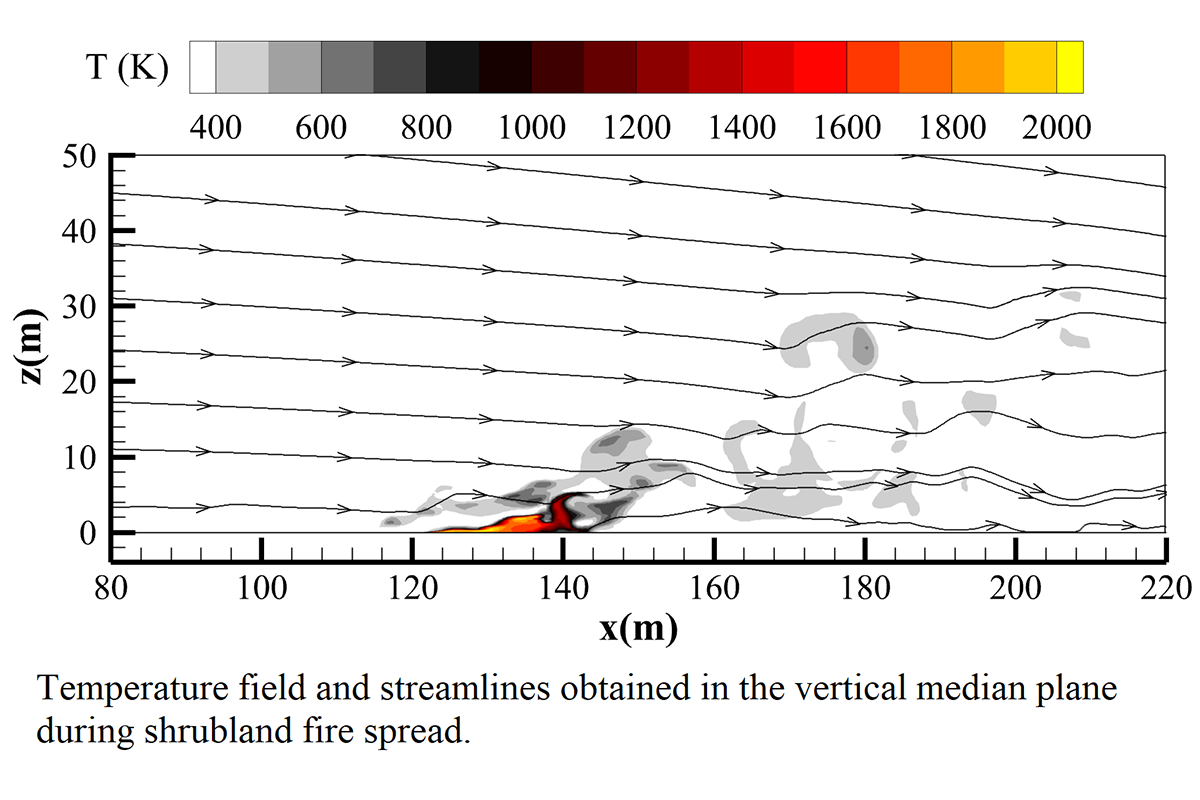
Wildfire propagation results from complex interactions between combustion processes, fuel properties, atmospheric conditions, and flow dynamics. This study presents a numerical parametric investigation of wildfire behavior using a fully physical wildfire simulation model. A reference simulation was first established in a computational domain representing a surface fire propagating through a vegetation layer under wind-driven conditions. A mesh sensitivity analysis was performed to identify an appropriate spatial resolution balancing numerical accuracy and computational cost. Fifteen combustion, vegetation, and environmental parameters were then investigated through a one-factor-at-a-time sensitivity analysis. The studied parameters included wind velocity, air temperature, relative humidity, turbulence intensity, dry packing ratio, dry fuel load, surface-to-volume ratio, fuel-bed height, moisture content, particle shape, dry fuel density, carbon content, drag coefficient, pyrolysis heat, and dry-fuel specific heat. The influence of each parameter on wildfire behavior was evaluated primarily through the rate of spread (ROS) and fireline intensity (FI). The results showed that fuel-bed height, moisture content, drag coefficient, and dry fuel load exerted the strongest influence on wildfire propagation. Increasing fuel-bed height and reducing fuel moisture significantly enhanced both ROS and FI, while increased aerodynamic resistance within the fuel bed strongly suppressed combustion and spread. The study also highlighted non-intuitive coupled behaviors, including a reduction in ROS at higher wind velocities for the considered configuration, emphasizing the complexity of fire-atmosphere interactions. Statistical screening using a preliminary mixed-parameter design confirmed the dominant role of wind velocity, fuel structure, and moisture-related parameters. Overall, the study identifies the most influential parameters governing wildfire propagation in the considered configuration and provides physical interpretations of the observed trends based on coupled thermal, aerodynamic, and combustion mechanisms. The work also proposes an improved constrained mixed-parameter methodology for future wildfire sensitivity studies.