SLIPT-Based Hybrid VLC/RF Cooperative Communication through Harvest-Store-Use (HSU) Relays
Project Details
- Student(s): Nour Rajeh and Lourde Gerges
- Advisor(s): Dr. Chadi Abou Rjeily
- Department: Electrical & Computer
- Academic Year(s): 2024-2025
Abstract
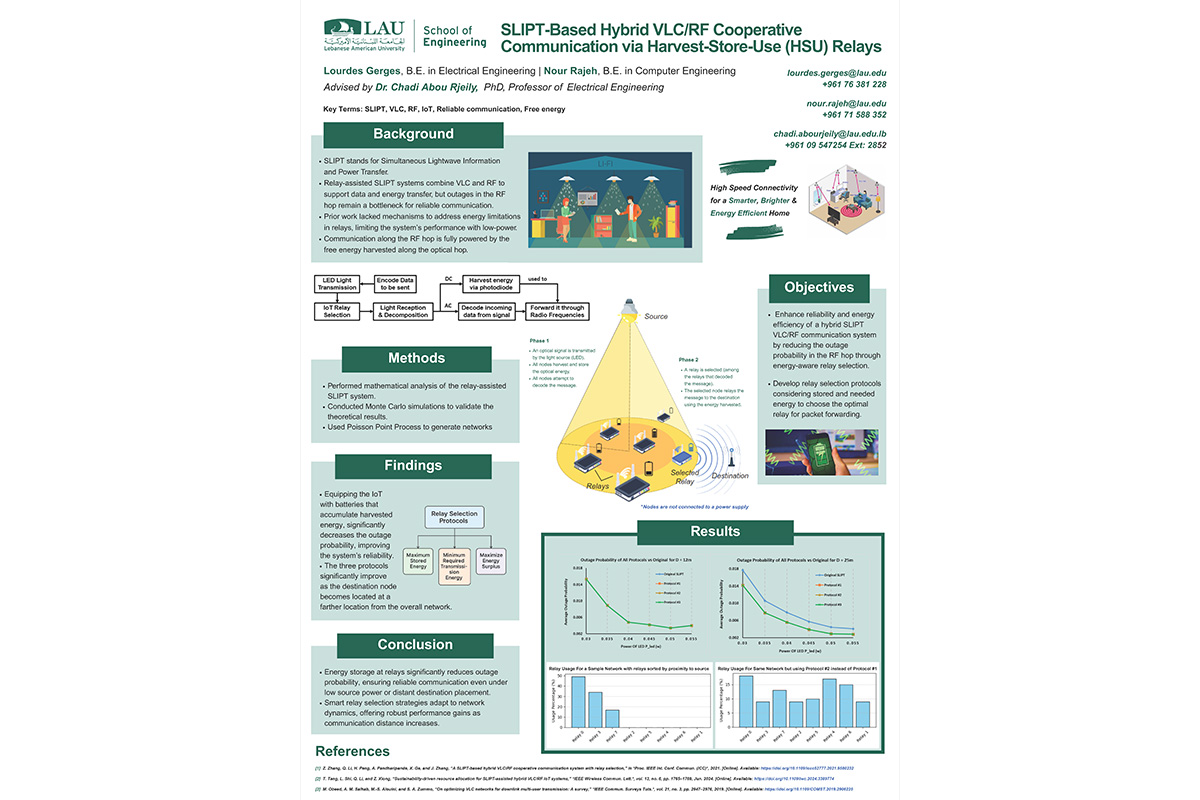
This research targets Relay-Assisted communications in hybrid Visible Light Communication (VLC) / Radio Frequency (RF) wireless networks. The relays are not equipped with permanent power supplies and they are powered solely by the optical energy harvested from the VLC access point based on the concept of Simultaneous Lightwave Information and Power Transfer (SLIPT).
Previous research has explored the SLIPT-based approach with Relay Selection proposing a two-hop communication system. First, the VLC access point transmits data to a group of randomly distributed relays that decode information and harvest energy along the VLC hop. The relay that successfully decoded the message and harvested the maximum energy relays the information to an outdoor node over the second RF hop.
Based on this foundation, this research focuses on investigating ways that concurrently improve the network reliability and energy efficiency. This can be achieved by equipping the IoT relays with energy storage capabilities allowing them to temporarily store the harvested energy for more efficient use in the subsequent time slots based on the Harvest-Store-Use (HSU) concept. As such, the target improvements will be achieved by proposing advanced Relay Selection protocols that maximize the batteries’ life times and/or minimize the amounts of transmitted energy by tracking the cumulative stored energies and the RF channel gains for optimal performance.