Temperature Dependent OCV-SOC Model for Lithium Manganese Iron Phosphate (LMFP) Batteries
Project Details
- Student(s): Taline Saad
- Advisor(s): Dr. Nagham El Ghossein
- Department: Electrical & Computer
- Academic Year(s): 2025-2026
Abstract
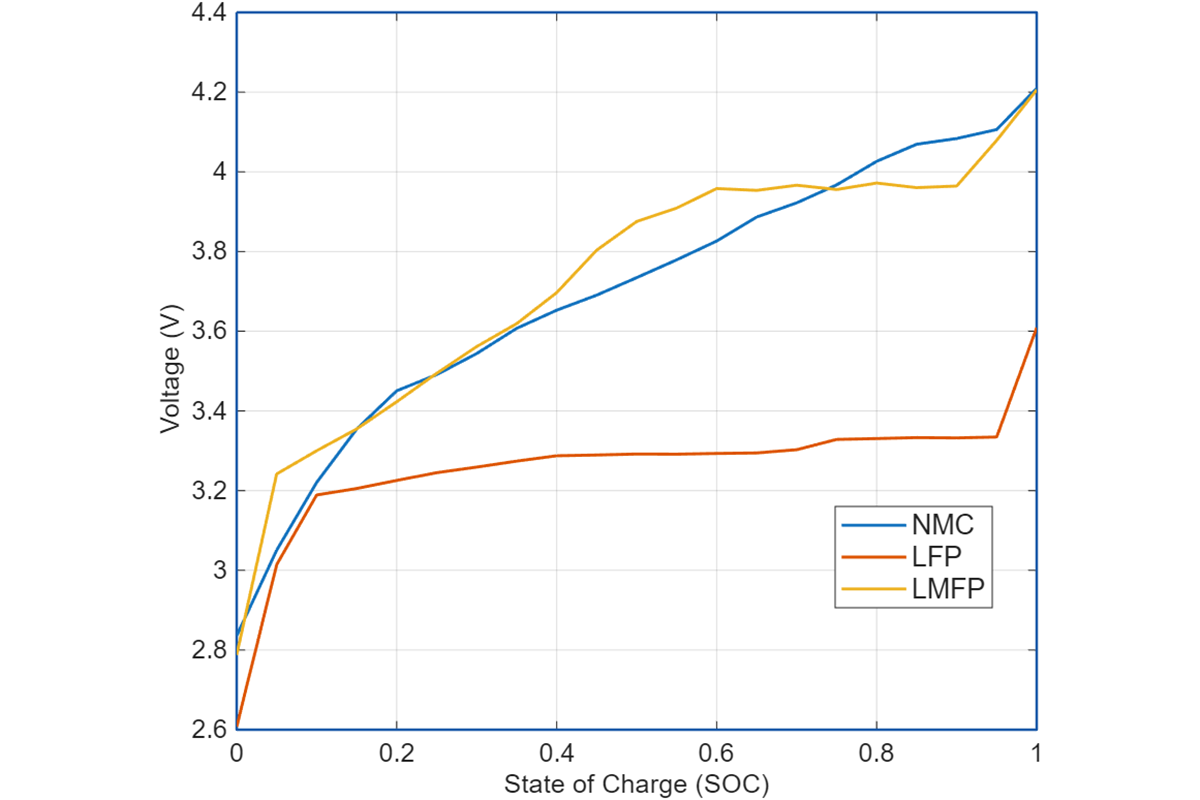
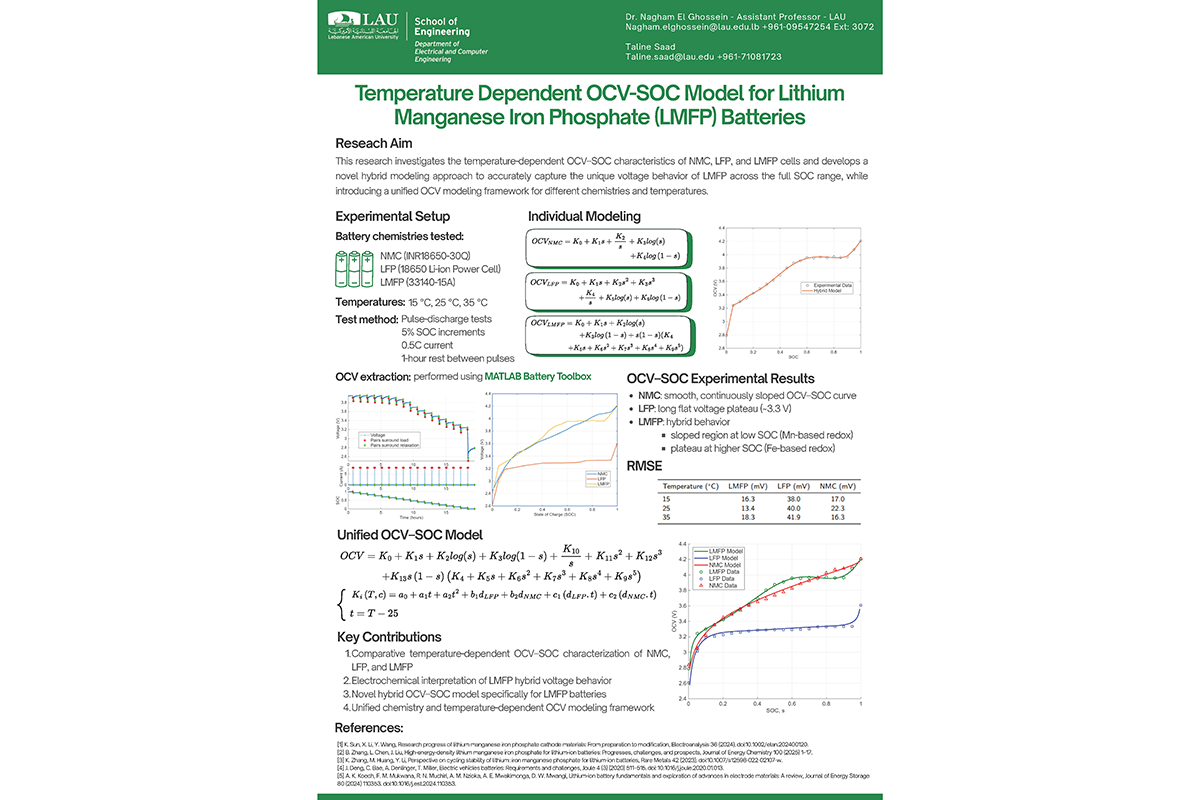
Energy storage systems (ESSs) are becoming increasingly important due to the growing use of renewable energy, portable electronics, and electric vehicles. Among Lithium-ion Batteries (LiBs), Lithium Nickel Manganese Cobalt Oxide (NMC) and Lithium Iron Phosphate (LFP) technologies are widely used, while Lithium Manganese Iron Phosphate (LMFP) is a newer cathode material that combines the safety and stability of LFP with a higher operating voltage similar to NMC. However, the Open-circuit Voltage (OcV) behavior and modeling of LMFP batteries have received limited attention. In this study, an OcV–State-of-Charge (SOC) model specifically developed for LMFP batteries is proposed and experimentally validated. Commercial NMC, LFP, and LMFP cells are tested at 15⁰C, 25⁰C, and 35⁰C using pulse-discharge tests to extract temperature-dependent OcV–SOC curves. The results show the characteristic voltage behavior of each chemistry: NMC exhibits a smooth slope, LFP shows a flat plateau, and LMFP demonstrates a hybrid behavior with both sloped and plateau regions. A novel hybrid OcV–SOC model is developed in this study to accurately capture the unique voltage characteristics of LMFP across the full SOC range. In addition, a unified temperature and chemistry-dependent OcV modeling approach is introduced for NMC, LFP, and LMFP batteries. The proposed models provide an accurate and practical foundation for battery management systems and performance prediction in electric vehicle and energy storage applications.