The Evolution Toward Explainable AI in fMRI-Based Autism Diagnosis
Project Details
- Student(s): Sara El-Kass and Elie Saab
- Advisor(s): Dr. Lina Abou Abbas
- Department: Electrical & Computer
- Academic Year(s): 2025-2026
Abstract
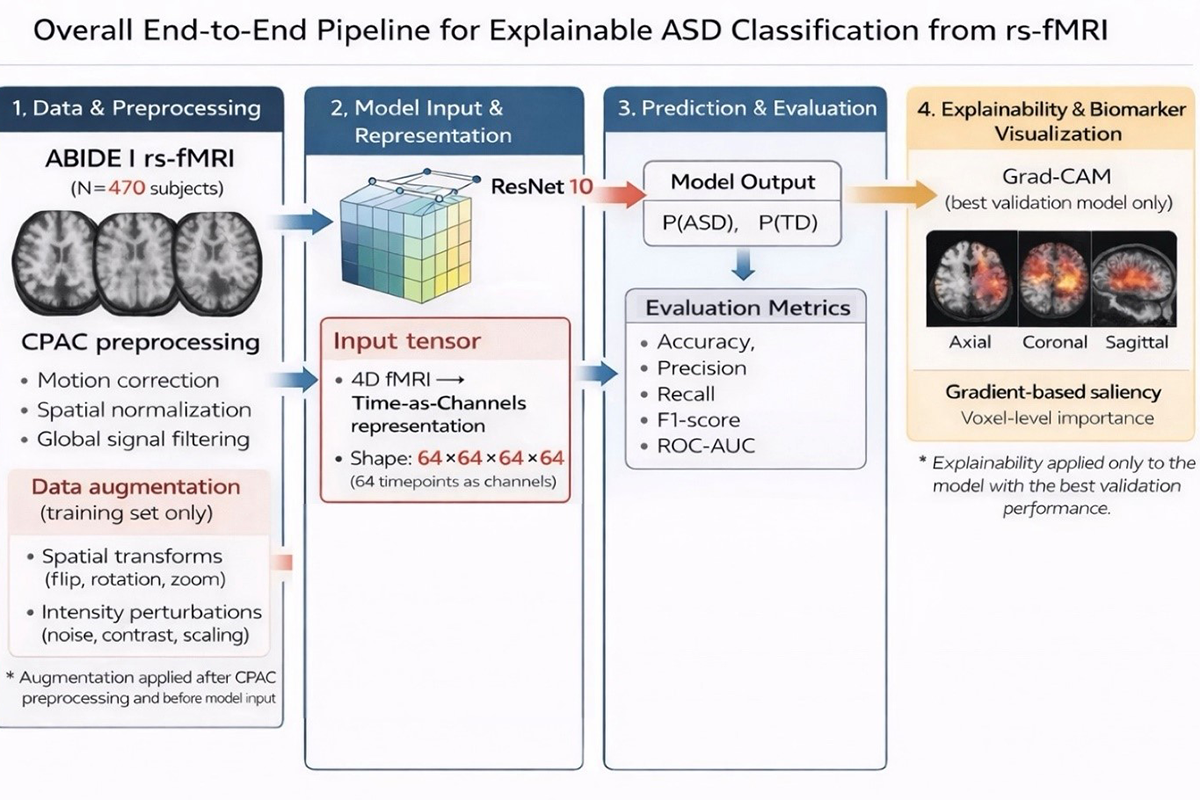
Autism Spectrum Disorder (ASD) is a complex neurodevelopmental condition whose diagnosis remains largely dependent on behavioural assessments, which are subjective, time-consuming, and sensitive to clinician expertise. Resting-state functional magnetic resonance imaging (rs-fMRI) offers a promising avenue for developing objective, biologically grounded biomarkers, yet translating neuroimaging data into clinically meaningful predictions remains challenging particularly in large, heterogeneous, multi-site datasets such as the Autism Brain Imaging Data Exchange (ABIDE). In this work, we present a unified deep learning framework for ASD classification using raw volumetric rs-fMRI data from the ABIDE I dataset. The proposed pipeline employs three-dimensional convolutional neural networks (3D CNNs) that preserve spatial structure while treating temporal information as input channels. To address overfitting and improve robustness, data augmentation strategies are applied. Model performance is evaluated using stratified training, validation, and test splits, and assessed with accuracy, precision, recall, F1-score, and ROC-AUC metrics. The final selected model achieves an F1-score of 0.756 on the validation set, reflecting adequate ability in a heterogeneous multi-site setting. The final selected model achieves moderate discriminative performance, characterized by strong sensitivity to ASD cases and stable validation behavior across epochs, consistent with prior findings on the challenges of generalization in heterogeneous neuroimaging cohorts. Importantly, explainability is incorporated through Gradient-weighted Class Activation Mapping (Grad-CAM) and Gradient-based Saliency, enabling visualization of brain regions contributing to model predictions and supporting interpretability beyond black-box classification. Overall, this work contributes to the ongoing shift from purely predictive models toward explainable, biomarker-oriented AI systems for autism research. The results highlight both the promise and current limitations of 3D deep learning approaches on large-scale rs-fMRI data, and underscore the importance of harmonization, evaluation rigor, and interpretability for future clinical translation.